I’ve written before about the power of human touch in North and South. One of the aspects of Gaskell’s writing that I adore is how vividly she brings to life the very human emotions of her characters. Our modern impression of Victorian society has us feeling pity for those staid and distant Victorians, who are forbidden to express their real feelings under the crushing weight of propriety.
Although propriety was indeed a factor in controlling outward behavior, Gaskell lets us see what is underneath any tempered covering.
Her characters agonize, yearn, worry, regret, envy, and love. They are real human beings with mixed emotions and motives. And the deepest feelings are expressed not so much in dialogue as in the body language: gestures, touches, and looks.
Let’s take a look at three powerful scenes in the book that included a long, silent hug that showed deep emotion.
First, there’s the pivotal moment when Mr. Hale reveals his decision to leave Helstone to his daughter. This is explosive news to Margaret, and she rightly exclaims her disbelief:
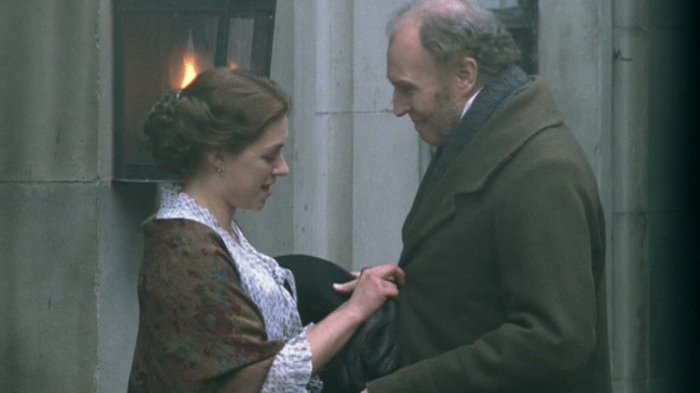
Margaret and her father have an affectionate moment. (from the BBC’s North and South)
‘Oh, papa, cried she, with sudden passionate entreaty, ‘say - tell me it is a night-mare — a horrid dream — not the real waking truth! …
‘I do mean it, Margaret. You must not deceive yourself into doubting the reality of my words - my fixed intention and resolve.’ He looked at her in the same steady, stony manner, for some moments after he had done speaking. She, too, gazed back with pleading eyes before she would believe that it was irrevocable. Then she arose and went, without another word or look, towards the door. As her fingers were on the handle he called her back. He was standing by the fireplace, shrunk and stooping; but as she came near he drew himself up to his full height, and, placing his hands on her head, he said, solemnly:
“The blessing of God be upon thee, my child!”
“And may He restore you to His Church,” responded she, out of the fulness of her heart. The next moment she feared lest this answer to his blessing might be irreverent, wrong — might hurt him as coming from his daughter, and she thew her arms round his neck. He held her to him for a minute or two…
This is a desperate yet tender scene between father and daughter. Mr. Hale’s decision to leave the church has been brewing in his mind for a long time, but it comes as a terrible shock to Margaret. Her whole life will be upended by this unwanted change.
Yet, their affection for each other remains constant. Neither wants to hurt the other, and Mr. Hale holds his daughter close for a few moments to confirm to himself the unwavering bond of care between them—despite the uncertain future.
The silent hug of “a minute or two” is profound, because the tenderness and love felt between people that have a deep shared history together can’t really be expressed in words. Holding tight to each other means much more. We’ve all felt the tremendous emotion of a silent hug, when seeing someone after a long separation, when sharing grief, when celebrating new chapters in life.
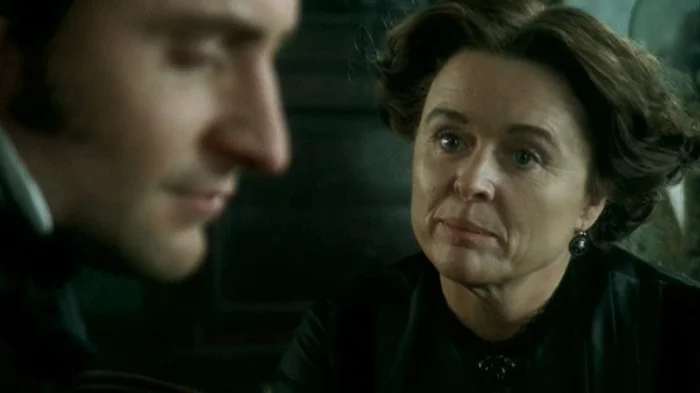
Hannah Thornton worries about her son when his business fails. (from the BBC’s North and South)
John and his mother have a similar moment of tender physical contact when the world they have built is collapsing around them. As John realizes that he can no longer afford to keep his mill running, his mother’s concern is evident.
“I sometimes have wondered where justice was gone to, and now I don’t believe there is such a thing in the world, —now you are come to this;
you, my own John Thornton, though you and I may be beggars together — my own dear son!”
She fell upon his neck and kissed him through her tears.
“Mother!” said he, holding her gently in his arms. “Who has sent me my lot in life, both of good and of evil?”
She shook her head. She would have nothing to do with religion just then.
These two have struggled through trauma and years of poverty together. They find binding strength in each other when all else is chaos. So in this moment it seems natural that John would hold his mother to him for his own comfort—and to comfort her. They still have each other, no matter what happens.
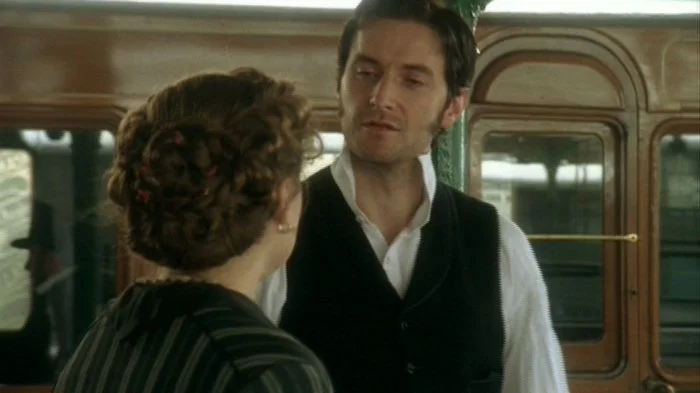
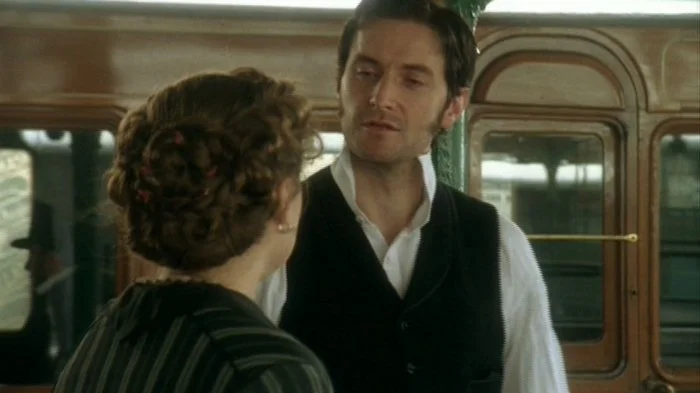
Just before they both truly understand the other’s feelings. (from the BBC’s North and South)
The sweet hugs between father and daughter/mother and son were born of harsh circumstances where the assurance of love was needed to buoy determination and strength to meet the future. But the final body-to-body embrace at the end of the book is not one born of hardship, but of unfathomable hope and joy!
I love the ending of Gaskell’s novel, where so much repressed love explodes into barely controlled passion!
By the time of this final scene, it has been about two years since the riot and John’s declaration of love for her. For nearly two years, they each have been suffering from the belief that the other did not love them.
When John comes to London, he hasn’t seen Margaret in over a year. When they are finally alone in in a room together, the passionate tension between them is palpable in every motion—every word. So when Margaret reveals her wish to loan him all her money to save his mill, the tension unravels:
His voice was hoarse, and trembling with tender passion, as he said:
“Margaret!”
For an instant she looked up; and then sought to veil her luminous eyes by dropping her forehead on her hands. Again, stepping nearer, he besought her with another tremulous eager call upon her name.
“Margaret!”
Still lower went the head; more closely hidden was the face, almost resting on the table before her. He came close to her. He knelt by her side, to bring his face to a level with her ear; and whispered—panted out the words:—
“Take care.—If you do not speak—I shall claim you as my own in some strange presumptuous way.—Send me away at once, if I must go;—Margaret!”
At that third call she turned her face, still covered with her small white hands, towards him, and laid it on his shoulder, hiding it even there; and it was too delicious to feel her soft cheek against his, for him to wish to see either deep blushes or loving eyes. He clasped her close. But they both kept silence.
Imagine the power of that “He clasped her close.”
He held her silently for a time while all that pent-up, agonized longing vanishes with the incredible realization that she loves him—his suffering turned to indescribable hope and joy.
She feels the same incredulous wonder as he holds her tight.
They will no longer be alone. A whole new life spreads before them! Words cannot convey the depth of feeling reverberating within them at this supreme moment.
THIS is the power of a long, silent hug.
And in this case, a few extra moments of “delicious silence” is just icing on the cake!