Being thrown from Paradise - for the better

Have you ever wondered how life would have turned out for Margaret if her father had stayed in Helstone?

Obviously, the entire story arc of North and South would be completely deflated. No move to the North would mean no Milton, no cotton mills, and no Thornton (gasp!). No encounter with new surroundings and mindsets.

And that’s the rub. Staying in Helstone and the gentler South would have given Margaret little opportunity to grow. So of course she needed to make that leap into the unknown for her personal journey! Literature like Gaskell’s North and South show us how unexpected trials can bring enriching change for the main characters.

Paradise.jpg

So away from paradise Margaret must go, although she loved it there so dearly! I often think of how she dreaded the move that ultimately led her to a more fulfilling life. It’s a helpful lesson to remember how human nature would resist change, especially if you believe you are perfectly happy and comfortable where you are.

And Margaret definitely didn’t want to leave Helstone. She had spent 9 years in London dreaming of going home to Helstone for good. It’s heart-rending that she is only given a few months to live there before her father’s decision tears her from her childhood home.

But how many years would she have truly been content to live in Helstone? Would her mother have tried to encourage a courtship between the Southampton carriage maker’s son and her daughter? Would Margaret have grown at all weary of the limited social contact and lack of intellectual stimulation?

Her love for her childhood home in the New Forest is unequivocally described in the book. Although Henry teases her about it being Paradise, she apparently does feel it is “the best place on earth.” To Margaret, it’s place of calm beauty — a place where she has freedom and where she has a helpful role in the community as the vicar’s daughter. Her status and position in Helstone are secure.

Her entire world comes crashing down around her the night her father tells her he’s leaving the church — that the family is moving to Milton. Everything will be turned upside down when they move to Milton.

Margaret soldiers on during the weeks of planning and packing. But her heart is heavy and she’s loathe to leave. On the day she leaves — that momentous day when one life chapter is closed— Margaret cannot contain her emotions.

Railroad time inexorably wrenched them away from lovely, beloved Helstone, the next morning. They were gone; they had seen the last of the long low parsonage home, half-covered with China-roses and pyracanthus--more homelike than ever in the morning sun that glittered on its windows, each belonging to some well-loved room…A sting at Margaret's heart made her strive to look out to catch the last glimpse of the old church tower at the turn where she knew it might be seen above a wave of the forest trees…She leant back and shut her eyes, and the tears welled forth…

After living in such a beautiful place, it’s a depressing adjustment to live in the thick of an industrial city. The transition to the dirty, bustling city is difficult for the women of the house — for those clinging to the past. The scenery around them is dreary, it’s foggy and cold, their living quarters are much smaller, and they know absolutely no one in town.

But Margaret’s horizons will be broadened, she will meet people who will enrich her life, she will find a life purpose that engages all her soul, mind, and heart. She will meet someone who matches her passions and intelligence and will cherish and encourage her spirit. In Milton, she will find love — and her home.

contemplating.jpg

I love the scene of Margaret’s arrival at the mill — a place, unbeknownst to her, which will become so vital to her future.

As she impatiently waits to speak to the man who will someday become her husband, she takes a turn about his office with curiosity. I always hold my breath as she examines the handwriting of the one who manages the great factory.

The magic of what is about to happen is suspended in this quiet, reflective moment. For she is about to burst into the center of John Thornton’s world (and explode it!). Nothing will ever be the same for her again.

It takes time, lots of tears, and great doses of humility and patience. But at the end of all her struggles there is this:

Better.jpg

I believe in finding John Thornton she has found a new Paradise! Now she will always be able to praise the day she left Helstone.


Thanks so much for following my blog. I know I haven’t been tending to it very well this year. It’s been a year of tremendous challenges and changes for everyone.

It’s been an especially huge year for my family. And I think you’ll understand why I’ve been too preoccupied to blog. We’ve moved across the continent! I’ve been busy planning and packing and traveling. And unpacking and exploring and settling in. It’s been quite an adventure for us this year as we moved from a major metropolitan area in California to a small slice of quiet paradise in Vermont.

Having never lived in a rural area before, I feel much closer to Margaret’s heart now in loving the beauty around me here. It fills the soul. And like Margaret, I find myself wanting to be outside as much as possible.

IMG_1514.jpg
IMG_1309.jpg

I hope everyone is doing well and learning lessons on what is really important in life. I know I still am.

Vermont+1.jpg


Confessions of a limited Richard Armitage fan

My introduction to Richard Armitage is a common story. At least is used to be, before The Hobbit movies began rolling out.

Like thousands of other soon-to-be-smitten fans, my very first glimpse of the actor was as the imposing mill master in the BBC’s North and South. The opening scene is definitely not my favorite, but I was completely won over by the vulnerable Victorian industrialist by the end of episode two.

Unbuttoned and emotionally unravelling, John Thornton wants desperately to believe what his mother is saying.

Unbuttoned and emotionally unravelling, John Thornton wants desperately to believe what his mother is saying.

That was October 2009. And I didn’t know that watching Richard Armitage bring John Thornton to life on screen would change my life. But it did.

I searched his name on the Internet. Who was this man, and why hadn’t I ever heard of him before?! I discovered, to my delight, that I wasn't the only one with a new obsession after watching North and South. C19.Proboards.com introduced me to the Richard Armitage fandom. And I — for the first time in my life — become a fan girl.

But here’s my guilty confession: I don’t think I’ve earned all the points necessary to be a genuine card-carrying Armitage fan.

You see, my interest in Armitage has centered rather heavily on his role as John Thornton. I’ve only ventured to see a very limited portion of his work. I’ve watched and loved Sparkhouse. And I thought he was sweet in The Vicar of Dibley. But I never really watched him as Guy of Gisbourne, or Lucas North. Just a little.

But I think I get fan points for going to the theater to watch Captain America, solely to exalt in seeing his name appear in the credits on the big screen that very first time. I was really excited.

And I was uncharacteristically jumping up and down with glee when I first heard he had landed the role as Thorin. I was ecstatic. Richard was going to be famous! It was a very special time to be in the Armitage fandom. We were all so very excited for our boy to be introduced to the world scene.

I watched all three Hobbit movies when they came out, even though I’m not really a big Tolkein fan. I did it for Richard. All to seem him in his glory.

But I haven’t seen him in anything else. I saw Castlevania’s first season. But I never got around to watching the rest. I don’t watch much tv —that’s my main excuse. But I still feel like I fall short of being a full-fledged fan. There are so many other shows I haven’t watched. And I haven’t even begun to listen to his audible books!

To all of my fellow Richard Armitage fans, I love our solidarity in fond admiration for a very handsome and incredibly talented actor. It’s been a great joy to “meet” so many of you!

To celebrate the blogging fandom, today is a celebration of those who have ever blogged about Richard: #RABlogReunion.

I didn't start this blog until 2016. But I’m still here. Still writing the occasional blog post about a story I love. A story that came to life on screen with phenomenal power due to Richard Armitage.

What have I been doing since I became an Armitage fan?

I’ve written two North and South variation novels, have helped compile an anthology of N&S short stories (Falling for Mr. Thornton), and am dabbling with writing a third variation. My focus has slipped on writing — real life concerns have been rather exhausting. I still visit and moderate the C19 site, but not nearly as often as I used to. The fanfiction sharing there has waned.

But if the era of my more eager fanhood has waned, I’ll always cherish those earlier, crazier days when the image of Richard as JohnThornton was never far from my mind — those days when I laughed and chatted and plotted with other Armitage fans online nearly every day.

Thanks, Richard, for enriching my life. Your contribution as an artist has had a profound effect on so many.


Moving forward through the darkness

Searching for a gleam of light

Searching for a gleam of light

There’s a tremendous amount of gloom and tragedy in North and South. Margaret Hale and John Thornton suffer great loss and struggle mightily to keep going, but they both find the strength to get up every day and continue on.

Gaskell’s story could be seen as a glimpse into the hardest three years of Margaret’s life. Seven deaths occur in North and South and all of them impact Margaret Hale. The four most personally felt—the deaths of Bessy, her mother, father and Mr. Bell—all take place within two years. Imagine suffering such a string of catastrophic losses at the age of nineteen or twenty!

Margaret’s first calamity is being forced to leave a beloved home. Moving to Milton is a harsh change for her, although there are definitely some hidden silver linings! But on the whole, things continue to worsen for her as her mother becomes more ill and Margaret finds herself constantly arguing with her father’s favorite student. Margaret’s main motivation through this stage of the story is to support her parents as best she can.

But before long, conditions and events in this new town begin to spiral completely out of control:

  • Her mother’s health takes a turn for the worse.

  • She gets injured trying to single-handedly stop a riot.

  • Her father’s best friend suddenly professes his love to her.

  • She forcefully rejects the town’s most eligible bachelor.

  • her new (and only) Milton friend dies.

Margaret still keeps going rather bravely for weeks until everything crashes to a halt with her mother’s death. But even then, Margaret does not have the luxury to break down and grieve. The very next evening she takes Fred to the station and everything goes terribly wrong. (Poor Margaret is caught up in dangerous violence again!) Mr. Thornton sees her with Frederick and she is forced to lie to the police.

This is a dark time for Margaret. Feeling she’s lost the respect of Mr. Thornton, and condemning herself for lying, she has lost some respect for herself in the bargain. She moves through life with no cheerfulness, trying to help others. Gaskell describes this period of gloom poignantly:

The dreary peacefulness of the present time had been preceded by so long a period of anxiety and care — even intermixed with some storms — that her mind had lost its elasticity. She tried to find herself occupation in teaching the two younger Boucher children, and worked hard at goodness…for her heart seemed dead to the end of all her efforts…her life seemed still bleak and dreary. The only thing she did well, was what she did out of unconscious piety, the silent comforting and consoling of her father.

The last goodbye

The last goodbye

Little did she know that this barren, calm period was only the receding wave, gathering in silence to unleash the final crashing wave of loss.

At the news of her father’s unexpected death, Margaret finally breaks down. She cannot rise from her grief and despair for several days. These are her darkest days, when she no longer has a family to live for, and is convinced she has lost the chance to have one of her own.

Margaret’s existence in London is almost mechanical. She has no heart for the life Edith leads and feels her soul revive only when alone with Edith’s toddler son or hearing someone talk of Milton. She spends several months in this mode of barely living before she searches deep inside to find a guiding principle to follow.

Mr. Bell’s sudden death causes Margaret to pray “that she might have strength to speak and act the truth forevermore.” To discover what that truth means to her, Margaret spends day after day sitting at the beach, contemplating her life until “she turned with all her heart and strength to the life that lay immediately before her, and resolved to strive and make the best of that.”

She returns to London with new vigor, taking “her life into her own hands” and acknowledging “her right to follow her own ideas of duty.” For Margaret, this means taking time to help the poor in London. Margaret finds life-giving meaning in helping others. It sustains her by giving her purpose, activity, and a sense of doing good. And although she still feels the pain of losing what might have been with Thornton, she has found a way to bring light into her life and move forward.

Of course Margaret is not the only one pushing valiantly on through a seeming tunnel of darkness. When we meet John Thornton, he has already passed through the signal tragedy of his life: his father’s suicide. The manner in which he and his mother fought through this deep trial to become outstanding members of society shows the great strength of character this man possesses.

But with Margaret’s arrival to Milton, the scene is set for Mr. Thornton to endure another great test of his strength. Her rejection of him shrouds his future in darkness, but he still has the mill to occupy his mind and the “stinging pleasure” of seeing her occasionally. It’s when she leaves Milton, that he is cast into a deep despair, as the famous scene in the BBC adaptation encapsulates so perfectly.

NS2004-EP4--0968.jpg

So, at the same time that Margaret is in London living a stoic half-life, going through the motions of life with barely any hope or joy—John Thornton is living a similar emptiness as he continues on without hope of having the life he truly wants.

Ah, but it gets worse. With the financial collapse of the mill, John is deprived of the purposeful work that keeps him going. Facing the loss of his lifework as well as the loss of Margaret as a life-partner, John stands on the brink of—for a second time in his existence—a deep chasm of darkness.

Thornton%27s+nadir.jpg

It is this battle-weary John Thornton that appears in my short story “Once Again.” I explore his inner struggle as he goes to London to sign the papers that gives up his connection to the mill.

My admiration for his strength deepened as I realized how much pain it must have caused him to see Margaret again, thinking she was destined to become another man’s wife. He could have declined the offer to dine at Aunt Shaw’s, but he must have been compelled to look upon the object of his deep passion once again. And so he goes to dinner….

I hope you’ll want to read how I portray his experience in London as he tries to move forward in spite of the gloom.

And what is it that propels him forward? It’s the same spirit that Margaret clings to: the desire to do right; the desire to be helpful to others. He won’t take work that only concentrates on the profit-motive. He wants to find work that will lift other men up in significant ways.

When his mother is lost in despair at the mill’s failure, she asks him what he will do—and he replies with this incredible, but time-tested battle cry in his darkest hour:

Be always the same John Thornton in whatever circumstances; endeavoring to do right, and making great blunders; and then trying to be brave in setting to afresh. But it is hard, mother. I have so worked and planned. I have discovered new powers in my situation too late — and now it is all over. I am too old to begin again with the same heart. It is hard, mother.

It’s because of the depth of darkness that both John and Margaret endure that it’s so heartening to see them find each other. We can feel how strongly united their spirits are. We know that the light of their love is going to be shining brightly for them through their future trials together.

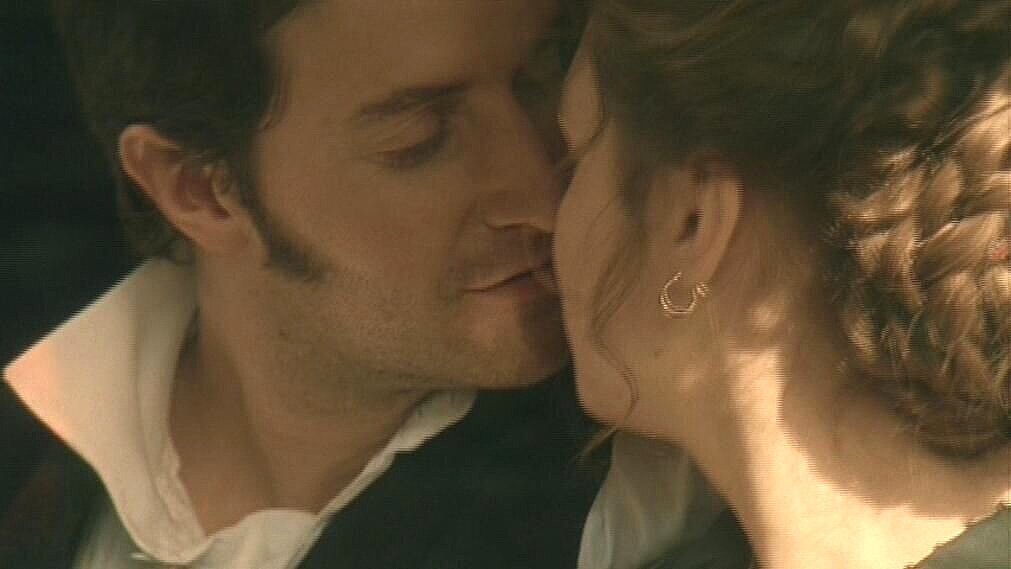
kissing.jpg

Despite personal and global unrest, strife and tragedy—I hope people can find the courage and strength to continue their struggle for bringing out good in the world. We need each and every one who has a heart to help others to keep going.

We’re going to make it out into the light.


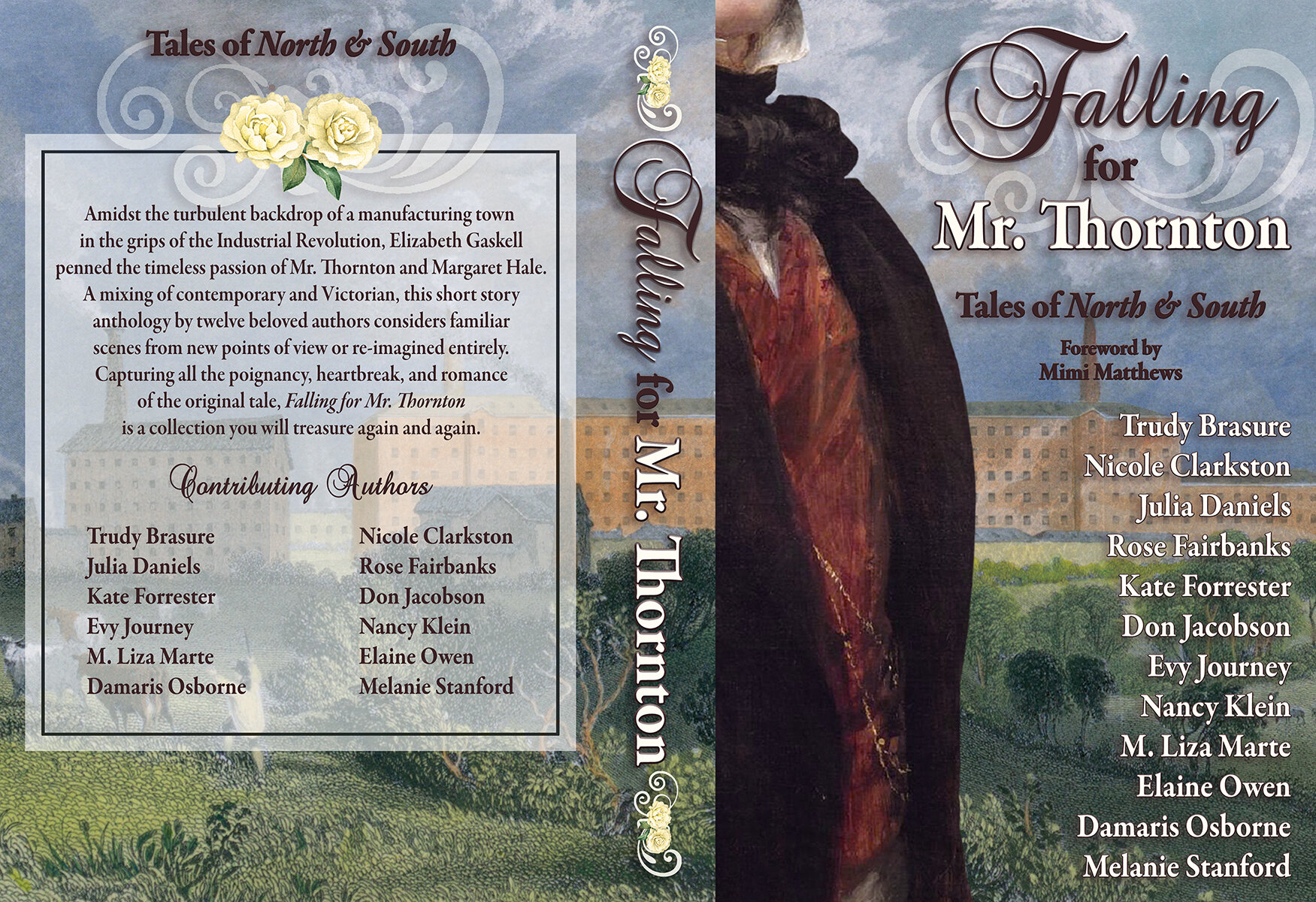
Falling for Mr. Thornton—Cover Reveal

cover reveal.png

It’s cover reveal day! And I’m excited to reveal the beautiful cover for our soon-to-be published collection of North and South stories!

With a just a glimpse of Mr. Thornton himself, JanetTaylor’s lovely artwork conveys the Victorian setting and the romantic aura that most of our stories include.

Here is the ebook cover:

FFMT Final FC woblod M.jpg

And here is the full paperback cover:

FFMT Final Full Wrappper wobld 110719 S.jpg

…And there’s a giveaway!

77094658_2468239483412994_7411073838567391232_n.jpg

Leave a comment below for a chance to win a copy of Falling For Mr. Thornton: Tales of North & South. The winner will be announced next week, on November 19th.

BLOG TOUR

Stop by More Agreeably Engaged for the launch of our blog tour on November 14. You’ll find out how each author became an ardent fan of North and South. (Clue: it often involves a British actor!)

November 14 - More Agreeably Engaged; Blog Tour Launch & Giveaway

November 19 My Jane Austen Book Club ; Author Interview & Giveaway

November 21From Pemberley to Milton; Review & Giveaway

November 25So Little Time…; Guest Post & Giveaway

December 5My Vices and Weaknesses; Review & Giveaway

December 10Diary of an Eccentric; Guest Post & Giveaway

December 16Babblings of a Bookworm; Review & Giveaway

December 20Austenesque Reviews; Guest Post & Giveaway


Follow us at our Facebook page to keep updated on all the activity about Falling for Mr. Thornton.

Hope you’re all excited as we are about expanding the Thornton lore out there!

Enjoy diving into more of John Thornton and Margaret Hale’s world when you pick up this new anthology.

The impact of North & South, 10 Years Later

N%26S.jpg

It’s my North and South anniversary this week! Ten years ago, in the middle of October 2009, I watched the first two episodes of North and South on Netflix with a friend who was at my house for girls’ movie night.

She came over the next week to watch episodes 3 and 4 with me. And after she left, I promptly replayed the train scene again at least twice. This is only normal procedure, right?!

The train scene was terribly beautiful. The best screen kiss I’d ever seen (still is!). But I think I know the exact moment I fell in love with the story’s hero. I was a goner when he made that breathy gasp of anguish, uncertain if he dared to hope Margaret might have feelings for him—that unbelievably vulnerable scene with his mother. This moment…

dare%2Bto%2Bhope.jpg

Honestly, I didn’t realize the impact the mini-series had made on me until I discovered that I COULD NOT STOP THINKING ABOUT IT.

Do you know what I mean? And here I was, rather isolated in a small California beach town with no one to talk to about it! And so I searched the Internet for “Richard Armitage.” Because WHO THE HELL WAS THAT MAN?! This was 2009. That is what you did then.

Blessedly, I was led to the N&S fan forum site: C19.ProBoards.com.

Huge sigh.

I had found my tribe. I was assured I wasn’t insane. At the C19 forum I discovered that many, MANY other perfectly respectable and well-educated women had tumbled into an obsession with the BBC’s North and South and Richard Armitage.

I admit it. Here and forever. As much as I profess to be in love with Elizabeth Gaskell’s book, I’m aware that it was Richard Armitage’s embodiment of John Thornton that threw me into the passion for North and South in the first place.

I’m not ashamed to say that I fell in love with a film production, a character, a story, a message because of one particulate actor’s magnificent, breath-taking, jaw-dropping, staggering performance of a relatively unknown romantic hero.

I am grateful for Richard’s part in this. I’m acknowledging his pivotal role in bringing Gaskell’s story to life for thousands. And I recognize that the entire film production was a masterpiece, and that it wasn’t just him.

BUT IT WAS HIM, in the end. Armitage made John Thornton real. And it was magnificent. Unforgettable.

So that’s what happened to me. I began to engage in the discussions about N&S at C19, even bravely beginning new threads of discussion with my own inquiries. And I discovered the wonderful world of fan fiction. Thus, I could indulge in more N&S and John Thornton for several weeks through some delightful stories posted there.

I bought the book about a month later and read it. I was expecting more Thornton. I rushed through it for the Thornton bits. I didn’t appreciate it as well as I should have the first go around. The impression of the film was still so strong.

But I was amazed at how vulnerable Gaskell made Thornton. She lets the reader see the struggling internal emotions of his angst. It is incredible. I’ve not found any classic literature to match it. And I’ve tried.

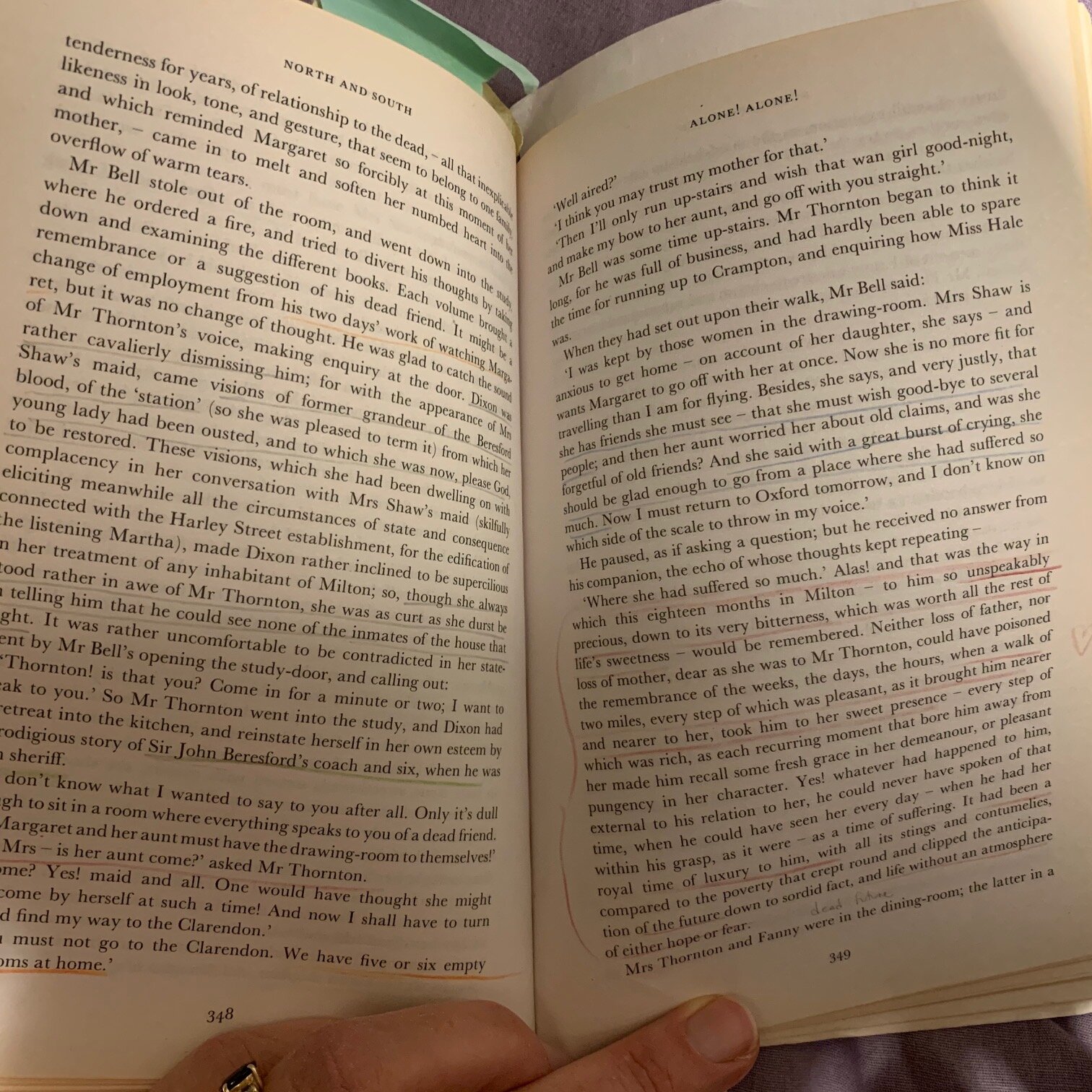
My original copy of North & South is full of penciled markings.

My original copy of North & South is full of penciled markings.

I started reading Austen, Hardy, Brontë, Dickens, Elliot, Trollope, and of course more Gaskell. Nope. Nothing beat North and South for the internal anguish of the romantic hero. John Thornton was king of all classic literature heroes. I had stumbled upon the gold standard. No wonder my world had been impacted when I saw him in the flesh on my TV screen.

Three months later, I was beginning to imagine an alternative scene to the “good-bye” scene in the mini-series. A month later I began to write it down as a story. And since C19 had fan fiction and welcomed new stories….I started to post my story that May.

In 2011, I published my story, A Heart for Milton. In 2014, I published another N&S variation, In Consequence. I’m still amazed I became a published author. It was never an aspiration of mine. I owe it to the passion I have for N&S that I discovered my talent for writing.

Along the way, I developed friendships, became a moderator at C19, read more classic literature. I helped promote other authors at The Armitage Authors Network blog and started this blog in 2016.

Right now, I’m excited to be working with eleven other authors to publish a collection of short stories! Falling for Mr. Thornton will be published in the coming weeks.

North and South has enriched and expanded my world. I certainly never expected my world to change forever when I pressed “play” ten years ago on Netflix. What happened to me is just proof of how powerful great works of art are to make us feel, to connect us, to make us explore being human.

I treasure most all the many friends I’ve made, and the great joy of reaching other people through my writing.

Thank you to everyone who has ever read this blog or my stories. Thank you to the BBC for an exquisite film production. Thank you, Richard, for making John Thornton come alive for us.

And thank you, Elizabeth Gaskell. Bless you for creating North and South. Bless you for creating John Thornton.

It’s been an amazing ten years.


Falling for Mr. Thornton - an anthology of N&S stories

This Fall, get ready to fall for John Thornton all over again…

…with a brand new collection of short stories!

Twelve authors are collaborating to bring a new book to your N&S collection soon!

Photo from the BBC’s mini-series masterpiece: North & South.

Photo from the BBC’s mini-series masterpiece: North & South.


Falling for Mr. Thornton: Tales of North and South

will be published sometime late October or early November.


Catch all the updates and details at our Facebook page.


Thanks so much for your interest — we’re excited to put out more North and South lore out there!


What if Margaret never married?

Mourning Margaret.jpg

Have you ever imagined a different ending to North and South—one where Margaret remains single the rest of her life? Would she find happiness and fulfillment without marrying John Thornton?

I occasionally run into North and South fans who wish the ending of Gaskell’s story wasn’t so traditional. Something in them cringes to watch the independently-minded Margaret Hale sign up for married life. And it bothers them that according to Victorian laws, Margaret would be turning over her entire fortune to John the instant they marry. These particular fans feel sad that Margaret would be giving up her independence.

I can understand their wish to see Margaret continue to be a strong model of womanhood. She acts like an equal to the men in her life, and shows no signs of depending on a husband to establish her identity. She follows her own individual convictions of what’s right or important. And it’s exciting to see a woman like that come into a large inheritance. Margaret’s wealth gave her more freedom to choose her own path.

So what was is it she wanted to do with all her money? Was she having a grand old time being rich in London? She wasn’t having a fantastic time spending her money on herself, or on making the social rounds. She is bored out of her mind living in a house full of people who only think of how to entertain themselves next. She certainly wasn’t interested in marrying just because that’s what you were supposed to do.

What did she want, after all? Did she want to be alone?

Abandoned+mill.jpg

The Margaret Hale in the last few chapters of the book is very melancholy. She spends a great deal of time trying to get over losing her relationship to John. She resolves to make the best of her life, despite her deep longing for “what could have been.”

Does Margaret want to have a family? Yes. Gaskell draws this desire out by showing how much Margaret loved it when Edith’s little boy fell asleep in her arms:

Those were Margaret’s sweetest moments. They gave her a taste of the feeling that she believed would be denied her forever.

But she’s not going to marry just anyone to have a family. She has made a commitment with herself to “speak and act the truth for evermore.” She’s already in love with Thornton. There’s no way she will compromise herself by marrying someone she doesn’t love. This is why Margaret tells Edith she will never marry. Margaret firmly believes she has lost her one chance at happiness.

I’m not buying the idea that Margaret would have been happier on her own than with John in Milton. I’m not able to imagine her living her best life all alone in London with no one to really understand her. Not a single person in her social circle comprehends her.

Standing+up.jpg

Margaret wanted to make a difference for others. She wanted to be involved in her community. She wanted to have a purpose beyond herself. She longs to love and help others. When she resolves to do as she pleases at Harley Street, she chooses to do charity work to fill her time and give her some purpose.

If she had lived her life alone, she would have continued to find ways to help people who needed help in London. This, she felt, was being true to herself. She would be satisfied in some sense, but I doubt she would ever be completely rid of the lingering sadness for the life she might have had.

I trust Margaret’s instincts for her own happiness. As a women wholly free to chose NOT to get married and to spend her wealth as she pleased, she chose to throw all her money into John Thornton’s hands. She offered him every pound she had in her account when she got the chance. She wasn’t interested in offering a token investment in his mill, she put her whole heart in her offer to help him revive the mill.

She trusted him with all her money, and wanted to join forces with him. And when he revealed his heart to her by calling out her name in earnest, she laid her head on his shoulders — she was tired of being alone. The relief and joy she and John both felt suddenly discovering that they would neither of them be condemned to a life alone is beautifully expressed in the holy silence described in those first few moments of physical contact:

…she turned her face, still covered with her small white hands, towards him, and laid it on his shoulder, hiding it even there; and it was too delicious to feel her soft cheek against his, for him to wish to see either deep blushes or loving eyes. He clasped her close. But they both kept silence.

It’s going to be a challenging life in Milton, but it’s the life she chooses, and she’s equipped for it. And she won’t have to spend the rest of her life kicking herself for turning down John Thornton!

The look of a woman who sees what she wants.

The look of a woman who sees what she wants.

All the World in Gaskell's North and South

Although Margaret Hale herself never steps a foot beyond England and not a single scene in North and South takes place abroad, Gaskell doesn't let the reader forget that England is the center of the world. The lives of her characters and the events of the story are intertwined with the larger activity of the Empire and the world beyond England’s shores.

On the very first page of North and South we learn that Edith will be married to an army captain stationed in Corfu — a Greek island that at the time was a British protectorate from the Napoleonic Wars. A few pages further in the book we find Margaret modeling luxurious shawls from India for Aunt Shaw’s friends. The opening chapter also reveals that the Lennox family is from Scotland. All three of these places — Corfu, India, Scotland — are part of England’s realm.

Edith enjoys the comforts of England’s wealth and power.

Edith enjoys the comforts of England’s wealth and power.

Gaskell begins and ends the story in London —the very hub of the great British Empire at the height of its power. Characters flow in and out of England throughout the book: Edith goes to Scotland and Corfu, Aunt Shaw vacations in Italy, the exiled Frederick risks coming home for a time from the sunnier shores of Spain, Irish workers are brought in to replace the striking mill workers, and John Thornton himself goes to France to find out what’s happening with the price of cotton.

England’s central role in the world of that era is undeniable, and Gaskell subtly but unmistakably hints at this global power when she makes references to the military presence of characters in far off places. General Shaw gave his wife shawls and scarves from India. Captain Lennox's regiment is sent to Corfu, near the Greek mainland. And Frederick was a midshipman in the Navy who led a mutiny somewhere in the high seas where a West-Indian steamer picked up the abandoned Captain Reid.

Frederick Hale is off to his Navy adventures.

Frederick Hale is off to his Navy adventures.

It is Frederick Hale that brings an element of the exotic world to Milton when he makes his daring visit to see his dying mother. The exiled Frederick tells his family about his adventures living in Mexico and South America. Frederick marries a Spanish girl and make the southern coast of Spain his permanent home.

Margaret on hill wider.jpg

Other countries or regions are mentioned incidentally in North and South:

Henry examines a copy of Dante’s Paradiso …“in the proper old Italian binding of white vellum and gold.”

Mrs. Hale keeps her letters from Frederick in the japan cabinet.

There are China roses covering the Helstone parsonage.

Mr. Bell asks Mr. Hale if perhaps Thornton and Margaret have “what the French call a tendresse for each other.”

And when the Hales arrive in Milton, Mr Hale rethinks his choice. “I wish I had gone into some country place in Wales." (Ah, but then they would never have met John Thornton!)

That Gaskell’s story should have so many references to the world beyond is no surprise, knowing how well the author liked to travel. Elizabeth loved getting away from Manchester and went several times to the Continent, often without her busy spouse. She traveled to Germany, Wales, Switzerland, France, Belgium, Italy, and Scotland. She also attended the Great Exhibition of 1851—that great showcase of innovations and art, where all the world was brought to London. Of course she did!

Thornton+in+world.jpg

Placing John Thornton at the Great Exhibition in the film adaptation was a stroke of genius by BBC screenwriter Sandy Welch. In this cleverly constructed scene, we see Thornton as not merely as a Milton businessman, but as a master of a global industry—a man of great power in the ever-accelerating world of manufacturing.

It is England’s internationally renown industrial prowess, of course, that is central to the story. The cotton industry of Lancashire in which John Thornton is involved is at the very summit of the industrial revolution in mid-century England. And the business of making cotton cloth in England is unequivocally an international affair. Cotton is grown and imported from foreign lands, and the resulting cloth made at the mill is sold both in England and abroad. Mrs. Thornton boasts of her son’s position in the world: Go where you will—I don’t say in England only, but in Europe—the name of John Thornton of Milton is known and respected amongst all men of business.

We find details of some of the issues of international trade and finance that affect his business in Gaskell’s book. Thornton speaks of the American competition in the yarn market that forces him to lower prices, making him unable to give the workers the raise they demand. And in the end, it is an American exchange house that begins the tumble of the financial markets across the ocean, and which ultimately forces Thornton to close his mill.

In the closing chapters of the story, as the lovers finally break through the misapprehensions keeping them apart, Gaskell is still weaving strong tones of far-reaching industrial power amidst emotionally intense romantic scenes:

Thornton leaves a very great impression upon Mr Colthurst, the Member of Parliament that comes to dine at Harley Street.

Margaret’s act of offering a loan to Thornton is an invitation to renew his business as well as a proclamation of her deep love and trust.

Far from concluding with a happy provincial ending, North and South leaves the reader with the strong feeling that together Margaret and Thornton will make a great impact in Milton that may just reverberate around the world.

The Fantastically Strong Women of North and South

Margaret.jpg

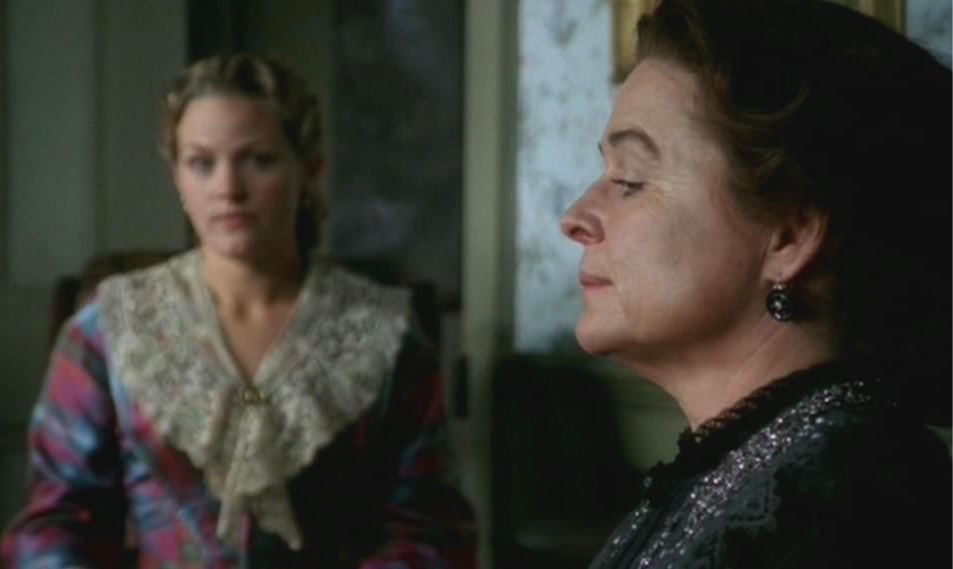
Who do you consider a strong woman in Elizabeth Gaskell’s story? I immediately think of Margaret Hale and Hannah Thornton for their amazing ability to endure whatever life throws at them. Edith, Fanny, and Aunt Shaw are models of the more fashionable and useless Victorian woman — living a coddled life of vanity where problems must be invented in order to have something to complain about.

Weaker women tend to complain a lot, they’re often unable to make decisions for themselves, they can’t cope with stress or tragedy, and they hardly bother to think of how situations or events affect others — they’re too consumed with their own concerns or wants. Weaker women let society and fashion mold them.

In contrast, strong women keep their complaints mostly to themselves, make decisions without consulting others, handle stress and tragedies without shutting down, and most importantly — they think of how their actions affect others. Strong women create their own path in life.

Margaret picks up the slack in housework

Margaret picks up the slack in housework

Of course, we all have our weak moments (or days or years), and I’m not saying that Margaret is always strong. On the contrary, she has her breakdowns — although they are kept very private. She’s human and she cries and complains at times. But she keeps moving forward, despite all that happens to her.

Margaret’s ability to remain strong throughout three long years of endless troubles impresses me. She’s a great model for feminine fortitude for her era. What proves she can carry herself through any situation? Here’s an incomplete list of situations she manages all on her own during the events of the novel:

  • Keeps a sense of self-worth while serving as a companion to her wealthier and prettier cousin

  • Accepts the task of dropping an emotional bomb on her mother, for her father’s sake

  • Shoulders the responsibility of moving a household when her parents can’t cope

  • Leaves a beloved childhood home for a darker, dirtier place without complaining

  • Tries to soften her mother’s complaints and keep a cheerful attitude to keep her father from slipping into depression

  • Argues with a respected businessman about his questionable moral attitudes toward laborers

  • Tries to single-handedly stop a riot

  • Rejects Mr. Right who happens to be dad’s best friend (talk about complicated relationships!)

  • Consoles the father of her dead friend — the only friend she had made in Milton

  • Consoles her father and brother when her mother dies

  • Tries to keep her exiled brother from getting caught and sentenced to death

  • Endures severe social censure for containing her brother’s secret

  • Loses the respect of Mr. Right (she thinks)

  • Steps up to tell Mrs. Boucher her husband is dead

  • Tries to keep her father from devastating depression while she mourns her mother’s death

  • Loses her father and is forced to move from Milton

That’s a quite a lot to muddle through before you turn twenty-one! And throughout it all, Margaret maintains a remarkably strong sense of her identity and worth. She does not let others define her. She makes some courageous decisions and she accepts responsibility for following through. She’s the backbone of the family.

Hannah.jpg

In so many ways, Hannah Thornton is like Margaret. She suffers her hardships silently, takes decisive action when things get really hard, and does what it takes to keep her family going. The fact that Hannah didn’t wait around for charity or accept the stigma society placed on her family for her husband’s suicide tells you tons about this woman. She laid the foundation for John’s success, which required her to take a determined path centered on her own values, not the ones society laid out for her.ff

These two are the obvious powerhouse women of North and South, but I see a few others who were able to endure hardship and made great efforts to protect or help others:

Bessy Higgins

For a dying teenager, Bessy keeps her complaints to a minimum (how many teenagers do that?!) and doesn’t make a lot of drama. Even during her last dying days, she’s worried about her father and distressed about how her father is treating Boucher. She isn’t focused on her own condition or terrorized by it. Her passionate desire to calm her father is stronger than her own self-concern. Her last words to Mary are for her to keep her father from drinking. Clearly, she had a strong love for others.

Mary Higgins

Bessy’s younger sister stays in the periphery of the story, but she is a silent strength in her own right. There’s no indication that Mary is a troublesome or selfish girl. She works to contribute to the family and tries to be helpful. After Boucher’s death, Mary takes care of his children. Mary is actually the main breadwinner of the family while Nicholas is out of work.

Maria Hale

Maria.jpg

I had no intention of including Maria when I set out to write a piece about strong women. I’ve never been a fan of Maria; I have practice being very critical of her. When we first meet her in the book, she is small-minded, self-pitying, and a rather vocal complainer.

I tried to think if she had any strengths, and had an epiphany of sorts in realizing that she did. How did I miss it all these years? I had never really stopped to consider why—after years of making a habit of complaining—she suddenly keeps her serious illness a secret. She must have made this decision out of love for her husband, knowing it would be a terrible blow to him.

She didn’t want to distress her family with this trouble, so she kept her physical suffering to herself (and Dixon) as long as possible. I find her motive in doing this very noble. Whether or not her decision was wise or not, it demonstrated strong desire and self-control to protect others from emotional pain.

And so I have a new appreciation for Maria that I had not had before. She showed her strength in the end.

What strengths do you admire in the women of North and South?


The 7 scenes I wished were included in the BBC's "North and South"

N%26S+intro.jpg

The 2004 film adaptation of Elizabeth Gaskell’s North and South is a masterpiece. I have only a few criticisms, one of them being that it was too short! There was time for more — an hour more in this world would have been wonderful.

As a lover of the book, I can’t help bemoaning the absence of a few of my favorite moments.

Here are some of the scenes that I wished this cast and crew could have filmed for me:

1 - Mrs. Hale running into her husband’s arms.

Although Aunt Shaw tells us that Richard and Maria Hale married for love, we never really see this affection played out. Mrs. Hale’s rather tentative and polite smile as she takes her husband’s hand in the adaptation isn’t terribly convincing. There’s a poignant moment in the book, though, where we catch a glimpse of the affectionate bond between them. It’s when Mr. Hale returns home after Margaret had been given the dirty work of telling her mother of her father’s decision to quit the clergy and move to Milton.

….he opened the room-door, and stood there uncertain whether to come in. His face was gray and pale; he had a timid, fearful look in his eyes; something almost pitiful to see in a man’s face; but that look of despondent uncertainty, of mental and bodily languor, touched his wife’s heart. She went to him, and threw herself on his breast, crying out:

“Oh! Richard, Richard, you should have told me sooner!”

2 - Margaret sadly roaming the garden the night before she leaves her childhood home

The adaptation skips over so much of the beginning of the book, the viewer doesn’t truly get a full sense of how much strength it took for Margaret to come to Milton without crying for a week. I would have loved for the film to show Margaret busy packing crates of belongings while her mother languished in despair and her father busied himself in sorting his books — all this to give the viewer a sense that Margaret was the one who took over all the hard responsibility of moving.

But what would have been truly beautiful and poignant was if the film had showed Margaret walking through the property at twilight as she says her final goodbyes to the landscape she loves so well. Gaskell’s description of it in the book is very moving.

3 - Thornton carrying an unconscious Margaret up the stairs of his home

Margaret+out2.jpg

Ok, so Gaskell doesn’t exactly describe how he feels as he carries Margaret up to his drawing-room, but can you imagine the powerful emotions pulsing through Thornton as he carries a lifeless Margaret up the stairs?! This has got to be one of the most dramatic scenes you could make from this film!

Seeing her injured and holding her body close to his is shattering all the remaining emotional barricades he has tried to form around his heart. As he climbs the stairs, powerful feelings must be compounding — and it all explodes into this:

He bore her into the dining-room, and laid her on the sofa there; laid her down softly, and looking on the pure white face, the sense of what she was to him came upon him so keenly that he spoke it out in his pain:

“Oh, my Margaret—my Margaret! no one can tell what you are to me! Dead — cold as you lie there, you are the only woman I ever loved! Oh, Margaret—Margaret!”

4 - Margaret pacing and crying in her room as she realizes she’s in love.

After Mrs. Thornton’s famous visit to give Margaret a tongue-lashing, Margaret runs upstairs to her room to sort out all the strong feelings rushing through her after the encounter. She realizes for the first time that Thornton thinks she’s in love with someone else—and she’s mightily distressed that he knows her to be a liar on top of it all! And so she finds herself crying as she gets ready to go out. Maybe in the film, she could whisper a few of her desperate thoughts to herself, to let the viewer know what turmoil is going on inside.

“I dare say, there’s many a woman makes as sad a mistake as I have done, and only finds it out too late. And how proudly and impertinently I spoke to him that day! But I did not know then. It has come upon me little by little, and I don’t know where it began….”

5 - Thornton being a comfort to Mr. Hale

The relationship between Mr. Hale and his would-be son-in-law is so beautifully portrayed in the book. I wanted to see more depth to this sweet bond shown in the film version. John is the only one Mr. Hale can really talk to during his great grief and these two men become very dear friends to each other. I would have loved to see just one brief scene in which Margaret sees her father clasp John’s hand as he is about to leave while Mr. Hale mentions how immeasurably better he feels after talking with him. Margaret’s awareness of how much her father loves and respects John, must be another binding reason for loving John.

“It was curious how the presence of Mr. Thornton had power over Mr. Hale to make him unlock the secret thoughts which he kept shut up even from Margaret…..Mr. Thornton said very little; but every sentence he uttered added to Mr. Hale’s reliance and regard for him. Was it that he paused in the expression of some remembered agony, Mr. Thornton’s two or three words would complete the sentence, and show how deeply its meaning was entered into….Man of action as he was, busy in the world’s great battle, there was a deeper religion binding him to God in his heart, in spite of his strong willfulness, through all his mistakes, than Mr. Hale had ever dreamed.”

6 - Thornton coming to dinner at Aunt Shaw’s house

This is the scene I long most to see on film! When Thornton comes to dinner in London, he and Margaret have not seen each other for over a year. The emotional tension is incredible as each of them strives to act as though this meeting again isn’t causing tremors of pent-up anguish within them. But alas, the internal agony slips into view for a brief moment from John. And Gaskell captures the moment so well, it’s just gut-wrenching. THIS is a moment Richard Armitage would have absolutely nailed. It would have been so brilliant to see this scene performed by the 2004 cast.

dinner+thornton.jpg

“…Margaret was watching Mr. Thornton’s face. He never looked at her; so she might study him unobserved, and note the changes which even this short time had wrought in him. Only at some unexpected mot of Mr. Lennox’s, his face flashed out into the old look of intense enjoyment; the merry brightness returned to his eyes, the lips just parted to suggest the brilliant smile of former days; and for an instant, his glance instinctively sought hers, as if he wanted her sympathy. But when their eyes met, his whole countenance changed; he was grave and anxious once more; and he resolutely avoided even looking near her again during dinner.”

7 - The kiss in Aunt Shaw’s back drawing-room.

I cannot criticize the final scene of the adaptation. It’s romantic film history. The symbolism and the drama is perfect. Do I care that it’s a public display of affection and would never have happened? No, it’s too romantically perfect to condemn. And I never shall.

However, if all my dreams were fulfilled, I’d love to see an alternate ending that follows that London dinner scene — the book’s more intimate ending, where the wall of misunderstanding crumbles down in private, without Henry’s peering glare!

What I miss most is the playful teasing between these two serious souls that turns into that toe-tingling tender-passionate first kiss that we all have watched a hundred times from the film. I’m imagining that very same kiss as Gaskell’s “delicious silence” — but in that elegant, private sphere where no one interrupts them. Although I can imagine that without that train whistle to interrupt things, it might be very hard to stop indeed!

What favorite moments from the book do you wish were included in the film version?